Few injuries strike more fear into athletes and their fans than a torn Achilles tendon. In just a split second, everything can change, leaving you or your favorite athlete out of the game for nearly a year, especially when it comes to Achilles injuries. It is well known that recovery from a torn or ruptured Achilles tendon is a long journey and is no easy feat. Combine the lengthy rehab and the fact that Achilles tendon injuries are generally difficult to treat due to the limited amount of blood flow found in tendons, it can be an athlete’s worst fear coming true.
As Dane Wukich, M.D. says, “The less blood delivered, the longer it takes for tissue to heal. Add to that the sheer size of the Achilles tendon, and you’re in for a lengthy recovery. Even for professional athletes, these are usually season-ending injuries, and in some cases career-ending injuries.”1
Fortunately, advances in biologic scaffolds are giving surgeons powerful tools to support tendon healing and recovery.2
What Is an Achilles Tendon Tear?
An Achilles tendon tear is a partial or complete rupture of the thick band of tissue that connects the calf muscles to the heel bone. This tendon plays a critical role in walking, running, and jumping, essentially any motion that involves pushing off the foot. Achilles injuries can range from small tears within the tendon to full-thickness ruptures that completely disrupt function and require surgery to repair.
How Do Achilles Tendons Tear?
Achilles tendon injuries often result from sudden stress or overuse. Common causes include explosive movements like jumping or sprinting, a quick pivot or abrupt changes in direction, or even tripping or stepping wrong during daily activities. In some cases, especially in middle-aged or less active individuals, the tendon may weaken over time due to chronic tendinosis or degenerative changes, making it more vulnerable to tearing during routine motion.
Certain risk factors, like tight calf muscles, limited ankle mobility, obesity, or structural deformities such as Haglund’s, can further increase the likelihood of a tear. When the tendon is already under stress, even a small trigger can lead to injury.
Who Is Most Likely to Need an Achilles Tendon Repair?
Achilles tendon repairs are typically performed when the tendon is torn, ruptured or severely degenerated and conservative treatments like physical therapy or immobilization haven’t been effective. While anyone can injure their Achilles, some groups are more at risk than others.
Those most likely to need surgical repair include:
- Middle-aged adults who participate in recreational sports, especially those involving jumping or sudden starts and stops
- Patients with chronic tendinosis who develop progressive tendon damage over time
- People with structural issues like flat feet, high arches, or Haglund’s deformity that put extra strain on the tendon
- Individuals with limited ankle flexibility or tight calf muscles
- Patients with metabolic conditions or a high BMI that place added mechanical stress on the lower extremities
Achilles tendon injuries span a wide range of patient types, from elite athletes to everyday individuals, making it one of the most affected tendons in orthopedic practice.
A Challenging Case with a Different Approach
A 44-year-old woman with a BMI over 50 came in with persistent heel pain, arch collapse, and limited range of motion. Imaging confirmed tearing of the Achilles tendon, tendinosis, retrocalcaneal bursitis, along with a prominent Haglund’s deformity. When conservative treatments failed, the surgical team opted for tendon detachment and reattachment with a double-row technique, enhanced by the Integrity™ Implant.
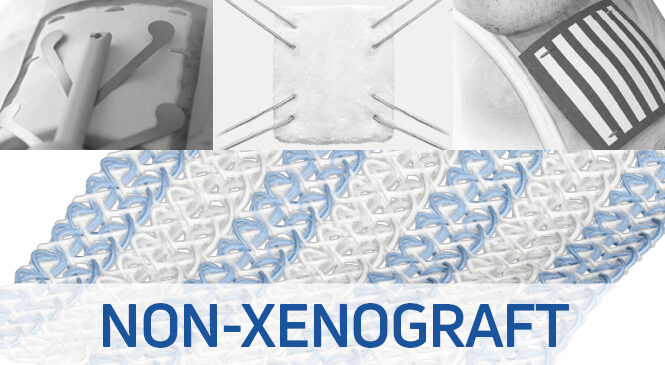
During surgery, the Integrity scaffold was placed beneath the Achilles tendon and secured with anchors to create a biologically active repair site designed for enhanced healing capabilities.
Within just five weeks, the patient reported no pain or swelling and was ready to begin physical therapy. For a complex Achilles repair, this early outcome speaks volumes. Cases like this show how biologic scaffolds are shifting the tendon repair market into one where biology and implant strength work hand in hand for better recovery.
What Makes Integrity Different
The Integrity Implant is built on Hyaff, a proprietary derivative of hyaluronic acid (HA). Unlike native HA, Hyaff is chemically modified to last longer in the body, giving it more time to work with the body to repair tissue. Hyaff supports key elements of tendon healing, like cellular migration, new blood vessel formation, and organized collagen deposition. As the Hyaff component of the Integrity scaffold gradually resorbs, it is replaced by structured collagenous tissue that promotes natural healing.3–
In addition to its 80% Hyaff composition, Integrity is reinforced with 20% PET, a high-strength polymer commonly used in surgical sutures. This permanent material is biostable and durable, providing a supportive framework that holds up under the demands of tendon-to-bone healing.
The result is a scaffold that does more than cover a torn Achilles, it actively contributes to the tendon repair process. It creates an ideal healing environment and helps guide the injury toward a more complete recovery.
References
- Londono R, Badylak SF. Biologic scaffolds for regenerative medicine: mechanisms of in vivo remodeling. Ann Biomed Eng. 2015 Mar;43(3):577-92. doi: 10.1007/s10439-014-1103-8. Epub 2014 Sep 12. PMID: 25213186.
- Data on file, Anika Therapeutics, Inc.
- Van Kampen, C., et al. “Tissue-engineered augmentation of a rotator cuff tendon using a reconstituted collagen scaffold: a histological evaluation in sheep.” Muscles, ligaments and tendons journal 3.3 (2013): 229.