Orthopedic care has come a long way. Surgeons now have access to materials and products designed to work alongside the body’s own healing process to help repair tendons, cartilage, and bone in ways that weren’t possible a generation ago. Biologic scaffolds are one of those advances.
If your doctor has mentioned a biologic scaffold as part of your treatment plan, understanding what they are and how they work can help you feel more prepared going into your procedure.
What Is a Biologic Scaffold?
A biologic scaffold is a structure that can help the body to heal and grow new tissue. Scaffolds can be made from natural materials, such as those derived from animal tissue, or from man-made (synthetic) materials that copy how tissues are built and held together.1
The scaffold acts like a support frame, allowing your cells to stick, grow, and form new tissue, such as tendons (muscles) or cartilage. The scaffold itself does not heal tissue; it gives the body’s natural healing process a structure to work within.
Where Are Biologic Scaffolds Used?
Biologic scaffolds have been used in many orthopedic surgeries, including tendon repair, bone healing (grafting), and cartilage repair.2
New research continues to study how scaffold materials and designs may work in other body parts and for different people as well. It’s an active area of science, and the clinical evidence behind individual products continues to grow.
How Do Scaffolds Work with the Body?
When tissue is damaged, the body responds by sending cells to the injury site to begin repair.3 A biologic scaffold supports this process by giving those cells a structure to work within. Cells stick, grow, and create new tissue around the “frame”. Rather than replacing the body’s healing response, the scaffold works with it, providing the physical support needed for tissue regeneration and healing to take place.
Most scaffolds gradually break down (resorbable or partially resorbable) as new tissue forms, leaving repaired tissue in its place. This is central to the regenerative medicine approach: to support the body’s natural healing process.
What Makes a Good Scaffold?
Designing a biologic scaffold means carefully thinking about a few important features:
- Biocompatibility: The material must be safe for the body and should not cause a reaction
- Bioresorbable: The scaffold should break down (resorb) in the body gradually over time, matching the body’s natural healing speed
- Porous Structure: A porous design (sometimes called “open”) allows cells, nutrients, and oxygen to move within the scaffold, finding space to stick and grow to make new tissue.
Together, these properties allow a scaffold to provide the support that tissue needs during the healing process.
What Material are Biologic Scaffolds Made From?
Biologic scaffolds are made from natural (animal, plant, or human) materials or manmade (synthetic) materials that copy how body tissues are built and supported. 1
Most biologic scaffolds are made from animal or human donor tissue. In this process, scientists remove the living cells leaving behind the natural structure of the tissue. This support helps the body’s own cells move in and grow new tissue.
Common Sources of Animal or Human-Based Scaffolds
Many scaffolds are made from animal tissues, such as:
- Pig (porcine)
- Cow (bovine)
- Horse (equine)
Some scaffolds are made from human tissue, including:
- Dermis: often used to repair soft tissue
- Pericardium: used in heart-related repairs
- Bone and cartilage: often used in cartilage repairs
- Tendons: used in tendon replacement repairs
Other Materials Including Synthetic and Bio-Based Scaffolds
Some materials are synthetic, meaning they are made by scientists for a specific purpose to aid in healing. Examples include:
- Fibrin: a naturally occurring protein formed from fibrinogen (derived from human or animal blood) that plays a key role in blood clotting; it is biocompatible, supports healing, and is safely broken down by the body over time.
- Synthetic and combination materials: some scaffolds mix natural materials with strong fibers, like polyethylene terephthalate (PET), to add strength for areas that carry a lot of weight
- Hyaluronic acid (HA) is a naturally occurring, gel-like substance found throughout the body, in joints, skin, and connective tissue, that encourages healing through its innate properties.⁴ For use in scaffolds, HA is modified from its native form into a solid, non-animal–derived material.
- Hyaff: a modified form of HA that can be made into a variety of solid forms and is used in some scaffold products
Choosing the Right Material
The best scaffold material depends on:
- The type of tissue being repaired
- How much strength the area needs
- How slowly the scaffold should break down
Each type of material has a purpose, and doctors and scientists continue to study how to use these materials to help the body heal in different ways.
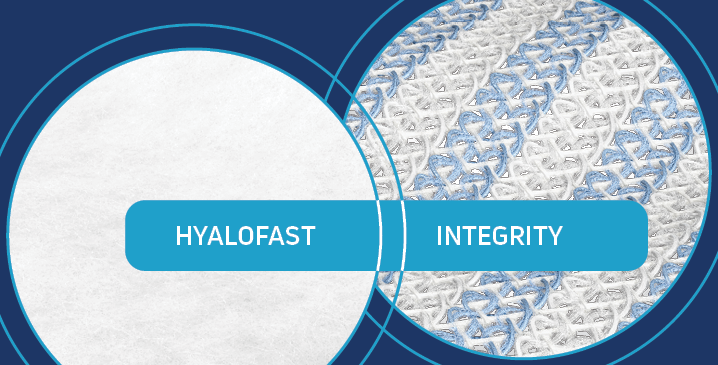
Biologic Scaffolds for Regenerative Medicine: Integrity and Hyalofast
Hyaluronic acid (HA) is naturally found in almost every part of the body and is essential for maintaining healthy joints and tissues.4 Inspired by the ability of HA to help repair the body, Anika made Hyaff, a modified solid form of HA that has been used safely in clinical applications for over 20 years.
Hyaff is a type of hyaluronic acid used in both the Integrity and Hyalofast scaffolds. Both products are biocompatible, fully or partially resorbable, and have an open, porous structure. They are also designed to support the body’s natural healing process without using animal tissue or human byproducts like collagen.
Hyalofast
Hyalofast is a hyaluronic acid (100% Hyaff) scaffold designed to support cartilage repair. It provides a 3D structure (biologic scaffold) that supports the body’s natural healing process at the repair site. Cells grow within the Hyalofast scaffold, helping new cartilage form and replace the damaged cartilage.
As new cartilage forms, Hyalofast slowly breaks down. As it dissolves, hyaluronic acid enriches the repair site, helping create a natural healing environment.
Note: Hyalofast is not currently available in the U.S.
Integrity
The Integrity Implant is an HA-based scaffold designed to augment, manage and protect tendon injuries and repairs including rotator cuff, Achilles, patellar, peroneal, gluteus medius, and quadriceps tendon repair.
The Integrity scaffold is 80% HA (Hyaff) and 20% PET (polyethylene terephthalate), a permanent material which remains in the body that provides strength to the scaffold. Over time, as the Hyaff portion breaks down, the implant site is enriched with hyaluronic acid, creating an optimal healing environment and supporting the body’s natural healing process throughout the tendon repair.
Not all products mentioned are available in every country. Availability may vary by region. Please contact us to learn more about the options available where you live.
What This Means for You as a Patient
If your doctor recommends a procedure involving a biologic scaffold, knowing what the different materials do can help you have a more informed conversation about your options. Scaffolds are designed to work with your body’s own healing process, providing structural support while your tissue repairs itself.
As doctors and scientists continue to study materials for biologic scaffolds, the value of biologic scaffolds will continue to grow. This is only the beginning of finding solutions that work with the body.
Want to Learn More?
Learn more about Hyaff or our proprietary hyaluronic acid technology fueling our regenerative solutions!
References
- American Academy of Orthopaedic Surgeons. (2024). Regenerative medicine. OrthoInfo. https://orthoinfo.aaos.org/en/treatment/regenerative-medicine/(opens in a new tab)
- American Orthopaedic Society for Sports Medicine. (2024). Tendon injuries: Patient information. https://www.aossm.org/(opens in a new tab)
- National Institute of Arthritis and Musculoskeletal and Skin Diseases. (2024). Bone, muscle, and joint health. U.S. Department of Health and Human Services. https://www.niams.nih.gov/(opens in a new tab)
- MedlinePlus. (2024). Hyaluronic acid. U.S. National Library of Medicine. https://medlineplus.gov/druginfo/natural/983.html(opens in a new tab)