Currently, very few implants in tendon repair can promise what Integrity does: true healing power without relying on animal tissue or byproducts. Many competing implants on the market today still rely on xenografts and/or materials derived from animal sources, such as bovine (cow) or porcine (pig) collagen. While these products, such as Biobrace® and REGENETEN®, are common choices for doctors, an increasing number of patients and surgeons are asking: Is there a better way?

We believe there is: Integrity.
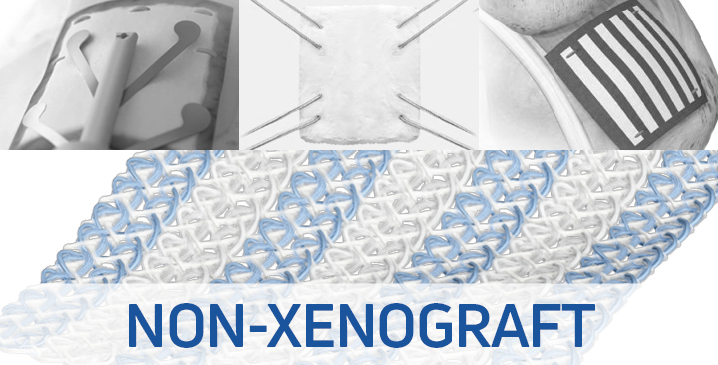
Unlike xenograft-based implants, Integrity is composed of Hyaff, a hyaluronic acid-based material and PET (polyethylene terephthalate). For patients, this means a solution free from animal by-products, which provides significant reassurance for those concerned about health risks, religious restrictions, or personal beliefs.1,2
The Patient Perspective: Healing Without Animal By-Products
A growing number of patients do not want animal-derived materials implanted in their bodies. For some, it is a matter of faith that prohibits the use of any animal by-products.1 For others, it is about trust in what is inside their body. Animal tissue raises concerns about triggering immune responses or introducing foreign animal DNA.1,2
Research has shown that bovine-derived collagen implants can cause mild immunologic reactions in some patients.3 While not always severe, the possibility of an inflammatory response is enough to make patients and surgeons think twice.
Integrity’s semi-synthetic biomaterial design removes that uncertainty. Its hyaluronic acid-based scaffold works in concert with the body’s natural healing response, utilizing a substance the human body produces daily, hyaluronic acid.
The Surgeon’s Perspective: Confidence in a Cleaner Option
It is not just patients driving the shift away from xenografts. Surgeons are also looking for better options. In a recent survey, 82% of surgeons surveyed by Anika reported an interest in using non-xenograft implants over animal-derived scaffolds whenever possible, citing that patients today demand greater transparency and reduced risks.4
As Dr. Timothy Codd said, “Having worked on the early stages of bovine collagen patches, it was fun and I loved it, but they are not doing what I need them to do. With the hyaluronic acid scaffold, we’re seeing clear advantages, like easier maneuverability to position it precisely for optimal healing, along with better protection of the torn tendon.”
With Integrity, surgeons can offer patients a non-xenograft option that aligns with modern expectations for safety, trust, and predictable outcomes.
Proven Science: Designed for Better Healing
The true advantage of Integrity lies not just in its non-animal origin, but in its advanced engineering design. First, its porous structure is engineered to support cell migration and tissue ingrowth, facilitating the scaffold’s natural integration into the repaired tendon. Research has shown that pore size and interconnected architecture directly influence how new tissue forms and stabilizes around the implant.5
In addition, Integrity is composed of Hyaff, a semi-synthetic hyaluronic acid-based technology. Hyaluronic acid is naturally produced by the human body, thereby supporting biocompatibility, resorption and natural healing.4,6 Studies on hyaluronic acid have demonstrated its ability to promote cell migration, tissue repair, and safe integration with minimal immune response.7,8
Lastly, Integrity is reinforced with non-absorbable PET (polyester suture material), which makes it strong to manipulate and secure into place.4
Together, this science-backed design provides the structural strength surgeons need with the patient-friendly biocompatibility that sets it apart from animal-based scaffolds.
A Clearer Path Forward for Patients and Surgeons
Today’s patients want options that align with their beliefs, health goals, and the right to choose what goes into their bodies. Surgeons seek solutions that meet these expectations without compromising patient outcomes. Integrity checks every box: no animal DNA and no hidden compromises; only proven science supporting a more trusted path to healing.
References:
- Offner D, de Grado GF, Meisels I, Pijnenburg L, Fioretti F, Benkirane-Jessel N, Musset AM. Bone Grafts, Bone Substitutes and Regenerative Medicine Acceptance for the Management of Bone Defects Among French Population: Issues about Ethics, Religion or Fear? Cell Med. 2019 Jun 20;11:2155179019857661. doi: 10.1177/2155179019857661.
- Colaço HB, Lord BR, Back DL, Davies AJ, Amis AA, Ajuied A. Biomechanical properties of bovine tendon xenografts treated with a modern processing method. J Biomech. 2017 Feb 28;53:144-147. doi: 10.1016/j.jbiomech.2017.01.011. Epub 2017 Jan 13. PMID: 28109536.
- Keane TJ, Swinehart IT, Badylak SF. Methods of tissue decellularization used for preparation of biologic scaffolds and in vivo relevance. Tissue Eng Part B Rev. 2014;20(3):197–205.
- Data on file.
- Karageorgiou V, Kaplan D. Porosity of 3D biomaterial scaffolds and osteogenesis. Biomaterials. 2005;26(27):5474–5491.
- Milella, E., et al. “Physico-chemical properties and degradability of non-woven hyaluronan benzylic esters as tissue engineering scaffolds.” Biomaterials. 23.4 (2002): 1053-1063.
- Migliore A, Procopio S. Effectiveness and utility of hyaluronic acid in osteoarthritis. Clin Cases Miner Bone Metab. 2015 Jan-Apr;12(1):31-3.
- Turner NJ, Kielty CM, Walker MG, Canfield AE. A novel hyaluronan-based biomaterial (Hyaff-11) as a scaffold for endothelial cells in tissue engineered vascular grafts. Biomaterials. 2004 Dec;25(28):5955-64. doi: 10.1016/j.biomaterials.2004.02.002